The 18-Day Battle in 18-Episodes
The number 18 holds deep numerical significance in the The Mahabharatha—the epic is written in 18 parvas or chapters; The Bhagavad Gita, a discourse from Lord Krishna to Arjuna, that elucidates the core philosophy of the epic (and life itself), consists of 18 chapters; the Kurukshetra battle too was fought over 18 days which consisted of a total of 18 Akshauhinis or armies.
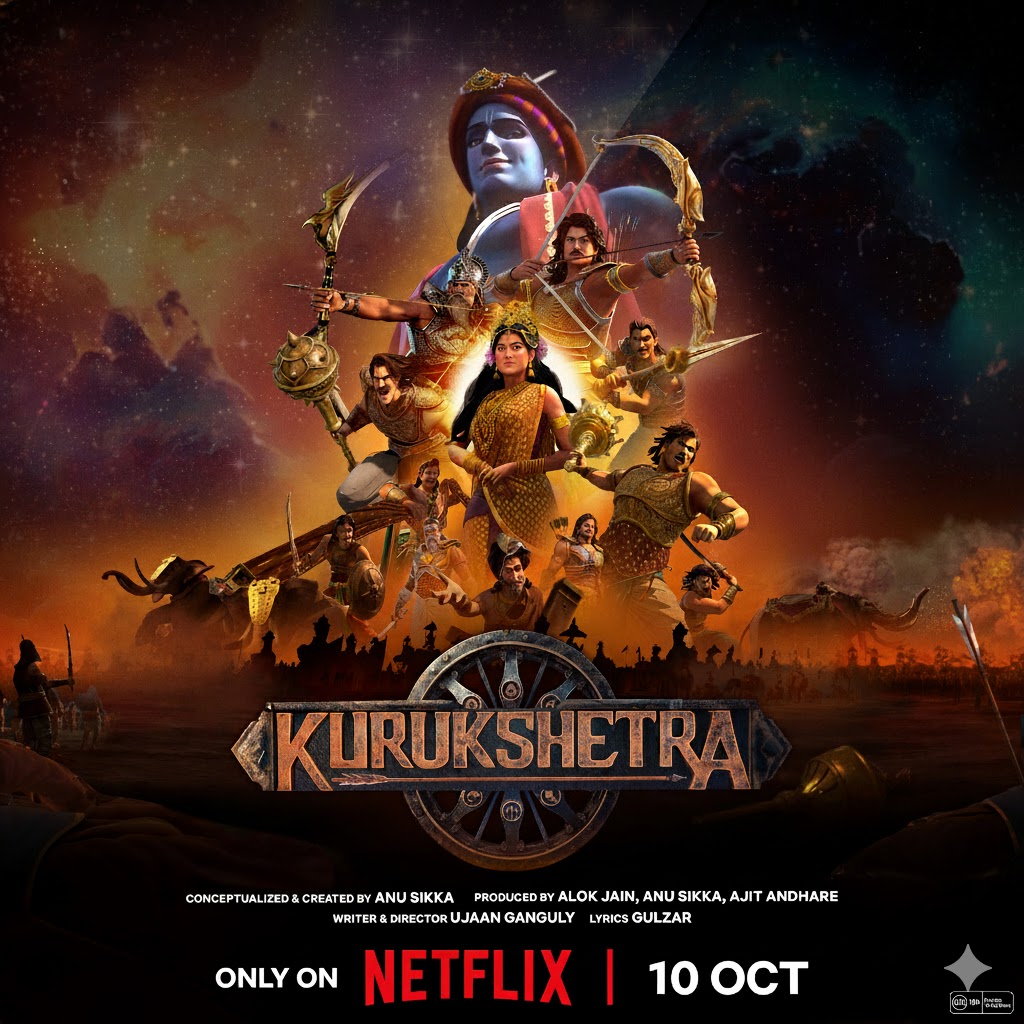
This recurrence of the number 18 in The Mahabharatha (and other Indian texts) is not mere coincidence but a nod to a number that symbolizes victory (the original name of The Mahabharatha is Jaya or Victory) and the totality of a cycle or system. So, when Netflix’s latest 3D animated series Kurukshetra was released in 18 episodes, narrated through the perspectives of 18 warriors in The Mahabharatha, it was a promising sign that the makers have taken great care to research their material.
And when the series kickstarts with a poetic prologue on the continuity of time and history by Gulzar in the auteur’s baritone voice, you know you are in for something special:
जो बीत चुका है वह सच मे बीता नही
अतीत मिटता भी नही दिखता भी नही
क्योंकि समय उसको अपने अंदर समो चुका है
और इतिहास के उस पार
हमारी सभ्यता का हिस्सा बन चुका है
Time marches forward but the past remains.
The past is neither erased nor visible.
For time has absorbed it into itself
To pass into history and
Become a part of our culture.
From here on, there’s no turning back, Kurukshetra surges forward straight into the events leading to the battle of Kurukshetra. For the uninitiated, Kurukshetra is one of the most important events in The Mahabharat (perhaps only after the Bhagavad Gita discourse), where two sides battle out their differences on the blood-soaked fields of Kurukshetra, which eventually transitions into an interplay of Dharma (righteous duty) and Karma (the universal principle of cause and consequences).
Kurukshetra does not shy away from the core philosophies, grim lessons, and moral complexities of the epic. When Abhimanyu is getting married to Uttara, Gandhari is having doomsday premonitions of death and decay; when the series begins, Yudhishtra is depicted as an epitome of righteousness, later we see him utter a half-truth (naro va kunjaro va) to help slay Dronacharya; despite being an incarnation of Lord Vishnu, we see Krishna strategize and turn the tides in favor of the Pandavas.
In other words, without diluting the essence of The Mahabharata, Kurukshetra raises all the pertinent questions and more:
Is war justified?
Is all fair in love and war?
Is God a trickster? Is he unfair?

Instead of treading the “modern-day retelling” path, Kurukshetra wisely chooses to stick to the original Mahabharata story and does complete justice. It introduces the epic to a new generation with its pacy screenplay, hard-hitting dialogues, crisp editing, and micro flashback narratives that lead us to the genesis of the events with intrigue and clarity.
The 3D animation, background score, and war staging are world class. My favorite being the battle formations or Vyuhas (Chakravyuha, Chandravyuha, Trishulvyuha) and the many action sequences.
Kurukshetra does for Gen Z what B R Chopra’s iconic TV serial Mahabharat did for Gen X and Millennials—reintroduce them to their own roots.
In a befitting finale, Lord Ganesha, the scribe, and Ved Vyasa, the author (and an important meta character) of this epic make special appearances to pass on the message that the battle of Kurukshetra isn’t just an epic of ambition, power, morals, deceit, righteousness, greed, envy, and love but also a timeless reminder that irrespective of the era or aeon, life doesn’t change; the doubts of the mind, life’s uncertainties, and questions of existence remain the same. Here, even the Gods are not spared from the consequences of their actions.Like Gulzar says:
अंत ही अंतिम है
नीचे भूमि ऊपर नक्षत्र है
यह कुरुक्षेत्र है!
This end, the finale is!
Witness, the earth below, the constellations above.
Yes, the Kurukshetra THIS IS!
 talking talkies